
Citrus powdery mildew
Alert
Be on the lookout for citrus powdery mildew and report any sightings immediately.
Reporting options
- Report online
- Phone Biosecurity Queensland on 13 25 23.
- Phone the Exotic Plant Pest Hotline on 1800 084 881.
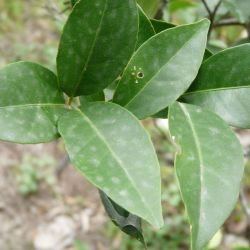
Early symptoms of citrus powdery mildew on leaves
© New South Wales Government
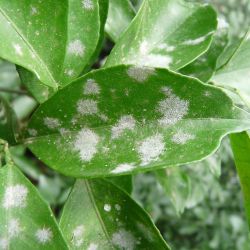
Citrus powdery mildew on leaves
© New South Wales Government
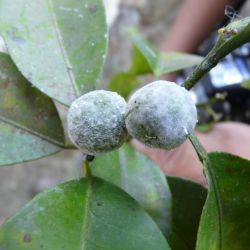
Young citrus fruit covered with white 'powdery' spores
© New South Wales Government
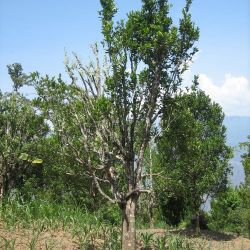
Tree dieback caused by citrus powdery mildew
© New South Wales Government
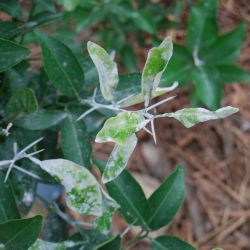
Distorted, withering leaves that have been infected with citrus powdery mildew
© A Beattie, University of Western Sydney
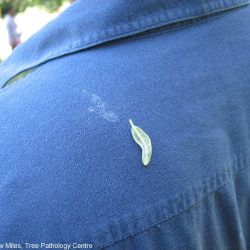
Tiny ‘powdery’ spores of citrus powdery mildew on clothing
© Queensland Government
Citrus powdery mildew is a fungal disease that causes leaf and shoot distortion, premature leaf and fruit drop, and twig and branch dieback. The disease can be a major problem in citrus nurseries. It has been reported to cause serious damage to mandarins, particularly nursery stock, in Asia.
Citrus powdery mildew is a plant disease and is not harmful to people or animals.
Cause
Citrus powdery mildew is caused by the fungi Erysiphe quercicola (citrus-affecting strains) and Fibroidium tingitaninum.
Powdery mildew on other crops, though similar looking, is caused by different species of powdery mildew fungi.
Other names
- Powdery mildew
Description
Symptoms
Leaves
- White 'powdery' spores develop mostly on the upper leaf surface.
- Young leaves turn a pale whitish grey-green.
- Leaves and shoots can distort.
- Young shoots can wither and die.
- Severe infection causes defoliation.
Flowers and fruit
- White 'powdery' spores develop on flowers and young fruit.
- Infected fruit falls prematurely.
Trees
- Plants can develop twig and branch dieback.
Plant stage and plant parts affected
- Infection usually appears first on new flushing leaves.
- All above-ground parts of the plant may be affected.
Distribution
The disease is common in parts of Asia, including South-East Asia (Java and Sumatra). There have also been reports from Uganda, Israel, Central America, South America, the United States (California), the Republic of Honduras and Antigua.
Citrus powdery mildew is not known to occur in Australia.
Hosts
All citrus cultivars can be affected. Some cultivars appear more susceptible than others. In India, the citrus varieties that are most susceptible are mandarins, sweet oranges and tangerines.
Plants affected
- Citrus
Impacts
Citrus is a significant crop in Australia with over 23,000 hectares of citrus planted. For the year ending June 2023, citrus production was valued at $977.1 million and Queensland was the largest producer of mandarins, lemons and limes.
Citrus powdery mildew can cause premature leaf and fruit drop, and twig and branch dieback. Severe infection can significantly reduce tree productivity, fruit quality and yield. If the disease spreads to Australia, farmers could experience production losses and increased costs associated with managing the disease. Market access could be disrupted.
Backyard citrus growers would also be affected.
How it is spread
This disease produces tiny ‘powdery’-looking spores that can survive on fallen leaves.
The spores can be transported:
- by wind
- on people (for example on clothing and/or hands)
- on equipment (such as pruning tools, mechanical harvesters and hedgers)
- on vehicles.
Movement of infected citrus plant material poses the greatest risk of introducing citrus powdery mildew to Australia. The Australian Government closely regulates approved host plant imports and monitors for illegal plant movement.
Monitoring and action
Check crops often. Look for plants that are unthrifty and that may also have dieback and fruit drop. Examine leaves, shoots, branches, flowers and fruit for white powdery patches of spores and distortion.
If you suspect the presence of citrus powdery mildew, report it immediately using 1 of these methods:
- Report online.
- Phone Biosecurity Queensland on 13 25 23.
- Phone the Exotic Plant Pest Hotline on 1800 084 881.
Prevention
The key method of preventing citrus powdery mildew entering your farm is to use certified disease-free planting material and have robust on-farm biosecurity systems in place.
Use these resources to help protect your farm from plant pests and diseases:
Legal requirements
Citrus powdery mildew is an exotic disease and its presence can lead to a biosecurity risk.
Under the Biosecurity Act 2014 , everyone in Queensland has a general biosecurity obligation to report biosecurity risks and take action to prevent or minimise them.