


Parthenium
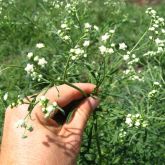
Parthenium flowers
© Queensland Government
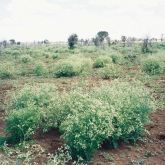
Parthenium infestation
© Queensland Government
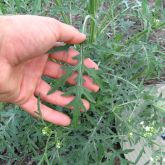
Parthenium leaf
© Queensland Government
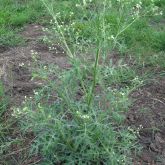
Parthenium plant form
© Queensland Government
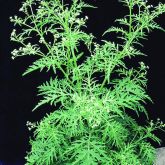
Parthenium plant
© Queensland Government
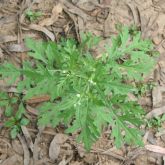
Parthenium seedling
© Queensland Government
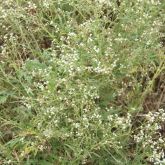
Parthenium plant with flowers
© Queensland Government
Native to North America, parthenium is an annual herb with a deep taproot and an erect stem that becomes woody with age. It invades disturbed bare areas and pastures. Parthenium costs Australia's beef industry $16.5 million per year and cropping industries several million dollars per year.
Scientific name
Parthenium hysterophorus
Other names
- Bitter-broom, carrot grass, congress grass, false camomile, false ragweed
Similar species
Description
- This annual herb grows up to 1.5m tall, developing many branches in its top half when mature.
- Leaves are pale green, up to 20cm long, deeply lobed and covered with fine, soft hairs.
- Flowers are small, creamy-white, on stem tips 4–10mm long and in a 5-sided shape.
- Flowers have 4–5 wedge-shaped black seeds, each 2mm long with 2 thin white scales.
3D model
- View the 3D model to help you identify this plant. You can magnify the image and manipulate the view to inspect the plant from every angle.
Habitat
- Grows in most soil types.
- Is most dominant in alkaline, clay and loam soils.
- Is found along roadsides and railway lines, and in pastures and disturbed areas.
Distribution
- Visit Weeds Australia and click on the distribution tab to view the distribution map.
Life cycle
- Germinates in spring and early summer, produces flowers and seed throughout its life and dies around late autumn.
- With suitable conditions (rain, available moisture and mild temperatures), can grow and produce flowers at any time of year.
- In summer, can flower and set seed within 4 weeks of germination, particularly if stressed.
Affected animals
- Humans
- Native animals
- Livestock
Impacts
Environmental
- Invades disturbed bare areas along roadsides, heavily stocked areas around yards, and watering points.
Economic
- Invades pastures.
- Reduces beef production.
- Costs cropping industries millions of dollars per year.
- Competes with crops for nutrients and space.
Social
- Can cause reactions such as dermatitis and hayfever due to potent allergens in pollen.
- Affects human health in several countries.
How it is spread
- Seeds are spread by water, vehicles, machinery and stock.
- Seeds are also spread by feral and native animals, and in feed and seed.
Prevention
Control
- Pastures maintained in good condition, with high levels of grass crown cover, will limit parthenium colonisation.
- Drought, and the subsequent reduced pasture cover, creates the ideal opportunity for parthenium colonisation when good conditions return.
Physical control
Hand weeding
- Hand-pulling small areas is not recommended because of the health hazard from allergic reactions and the danger of mature seeds dropping and increasing the infestation area.
Herbicide control
Non-cropping areas
- Spray early before plants can set seed. Keep a close watch on treated areas for at least 2 years.
- Treat small and/or isolated infestations immediately. Use a knockdown herbicide to kill plants that are present and a residual herbicide to control future germinations. You may need to repeat treatment (even within a single growing season) to prevent further seed production.
- For extensive infestations, use herbicide treatment in conjunction with pasture management. Time the spraying so that parthenium is removed when plants are small and before seeding has occurred. Grasses should be actively growing and seeding so that they can recolonise the infested area.
Cropping areas
- Use selective herbicides and/or crop rotations. For more information on parthenium control in crops, consult your local agronomist or local government.
Read the parthenium fact sheet to find out more about herbicide control and application rates.
Biological control
- A number of insect species and 2 rust pathogens have been introduced to control parthenium:
- Epiblema strenuana (stem-galling moth)
- Listronotus setosipennis (stem weevil)
- Zygogramma bicolorata (leaf beetle)
- Smicronyx lutulentus (seed weevil)
- Conotrachelus albocinereus (stem-galling weevil)
- Bucculatrix parthenica (leaf-feeding moth)
- Carmentia ithacae (root-feeding moth)
- Stobaera concinna (sap-feeding plant hopper)
- Platphalonidia mystica (stem-boring moth)
- Puccinia abrupta var. partheniicola (leaf rust)
- Puccinia xanthii var. parthenii-hysterophorae(leaf rust)
- Puccinia xanthii var. parthenii-hysterophorae (summer rust) (PDF, 2.2MB)
- Carmenta ithacae (root-boring moth) (PDF, 1.6MB)
- Smicronyx lutulentus (seed-feeding weevil) (PDF, 1.1MB)
- Listronotus setosipennis (stem-boring weevil) (PDF, 956KB).
- The combined effects of biological control agents reduce parthenium's density and vigour and increase grass production.
Legal requirements
- Parthenium is a category 3 restricted invasive plant under the Biosecurity Act 2014. You must not:
- give it away
- sell it
- release it into the environment.
- You must take all reasonable and practical measures that are under your control to minimise the biosecurity risks associated with dealing with parthenium. This is part of your general biosecurity obligation.
- Each local government agency must have a biosecurity plan that covers invasive plants in its area. This plan may include actions to be taken on parthenium. Some of these actions may be required under local laws. Contact your local government for more information.
If you do any of these, penalties may apply.
Further information
- Contact us online, by phone or in person.
- Read the parthenium fact sheet.
- Read Weeds Australia’s parthenium profile.
- View the parthenium 3D model.